From Prompt to Process: What Makes an AI Agent Different from a Chatbot
Chatbot, assistant, workflow, and agent — and why the difference governs oversight.
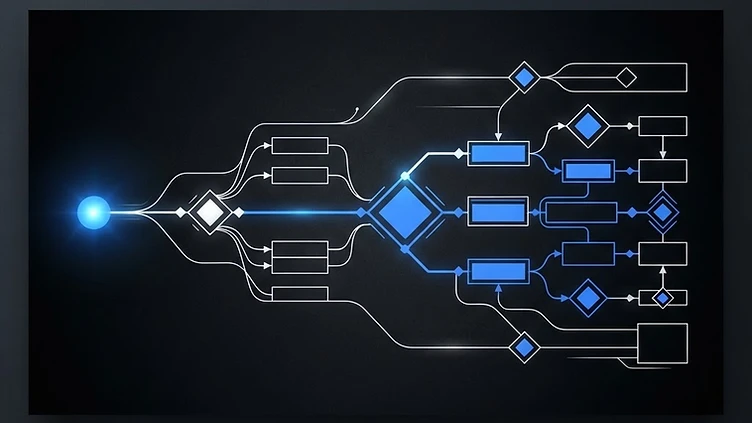
Most people first meet artificial intelligence through a chat window. You type a question, the system replies. That interaction is useful, but it is also where most of the confusion begins. When a vendor says a product is "agentic," they are describing something structurally different from a chatbot — and the difference matters for anyone responsible for how that software is used.
This explainer separates four terms that are often used interchangeably: chatbot, assistant, workflow automation, and agentic system. The distinction is not academic. It determines what the software can do on its own, what it can change in your environment, and what kind of oversight it requires.
Chatbot: a conversational interface
A chatbot is an interface, not a process. It accepts a message and returns a response. The work happens inside a single turn: input in, output out. A chatbot has no goal beyond answering the current message, no memory of past sessions unless one is bolted on, and no ability to take action in any system outside the conversation.
When a chatbot tells you how to reset a password, it has not reset the password. It has produced text about resetting a password. That gap — between describing an action and performing it — is the first thing to understand.
Assistant: a chatbot with tools and context
An assistant extends a chatbot in two directions. First, it can carry context across a conversation and sometimes across sessions, so it remembers what you asked a moment ago. Second, it can use tools: look up a calendar, search a document, run a calculation. The assistant still waits for you to direct it. It does not decide what to do next on its own.
The key property of an assistant is that initiative stays with the person. You ask, it responds. It may suggest, but it does not pursue a multi-step goal unless you drive each step.
Workflow automation: a fixed, predetermined path
Workflow automation is the opposite of a chatbot in one sense: it has no conversation, but it has a process. A trigger fires, and a predefined sequence of steps runs in a fixed order. If this, then that. The path is determined in advance by whoever built the workflow.
Workflow automation is reliable because it is rigid. It does exactly what it was told, in the order it was told, and nothing else. When conditions change in a way the workflow's author did not anticipate, the workflow either fails or does the wrong thing confidently. It cannot adapt, because adapting was never its job.
Agentic system: a goal pursued with planning and tools
An agentic system combines properties of the others and adds one more: it is given a goal, and it works out how to achieve it. To do that, it typically needs several capabilities that the other forms do not require.
Planning. Given a goal, an agentic system breaks it into steps and decides the order. This is the core difference from a chatbot, which has no plan, and from workflow automation, which has a plan someone else wrote. The agent generates its own plan, which means the plan can be wrong.
Tool use. An agent does not just talk about actions; it can take them. It can read from a database, write to a file, send a message, call an API. This is where the stakes rise. A chatbot that is wrong produces a wrong sentence. An agent that is wrong can move real data, spend real money, or send a real email.
Memory. An agent keeps state across its steps — what it has tried, what it learned, what it decided. Without memory, every step would start from scratch and the system could not coherently pursue a goal.
Permissions. Because an agent acts, it must be given permission to act. Which accounts can it access? Which records can it read? Which can it change? Permissions are the boundary that turns a capable system into a safe one.
Checkpoints. A well-designed agentic system is not a single uninterrupted run. It pauses at defined points for review, confirmation, or escalation. Checkpoints are where a person — or another system — can verify that the agent's plan still makes sense before it takes a consequential step.
Failure handling. Things go wrong: a tool is unavailable, a response is ambiguous, a step produces an unexpected result. A chatbot stops. A fixed workflow fails. An agent can recognize the problem and adapt — retry, choose a different approach, or stop and ask. How it fails is as important as how it succeeds.
Why the distinction matters
The four forms are not a ranking where "agentic" is best. They are different tools for different jobs. A chatbot is the right answer when someone needs information. An assistant is right when someone needs help with a task they still direct. Workflow automation is right when a process is stable and well understood. An agentic system is right when a goal is real but the path to it cannot be written in advance.
The trouble comes when these are confused. A team that buys "an agent" and receives a chatbot will be disappointed that it cannot act. A team that deploys an agent while treating it like a chatbot will be surprised when it does act — in systems they did not expect it to touch.
The practical question for any organization is not whether a system is "agentic" in marketing copy. It is: what goal is this system given, what can it do to pursue it, what permissions does it have, and where does it stop for review? The answers to those four questions describe what the software actually is.
Signal Check
- What happened: The industry has settled on "agent" as a label for systems that pursue goals with planning and tools, but the term is applied unevenly across products.
- Why it matters: Confusing a chatbot for an agent leads to unmet expectations; confusing an agent for a chatbot leads to unmanaged risk.
- Who it affects: Anyone evaluating, buying, or governing software that is described as agentic.
- What to watch: Whether vendors disclose the specific capabilities — planning, tool use, permissions, checkpoints — rather than the label alone.
Editorial Process
This publication was developed using The Agentic Editor's research and editorial workflow and reviewed for relevance, accuracy, context, and clarity.
The Weekly Briefing
Independent reporting and analysis on AI agents, emerging technology, and the companies building them—delivered once a week.